
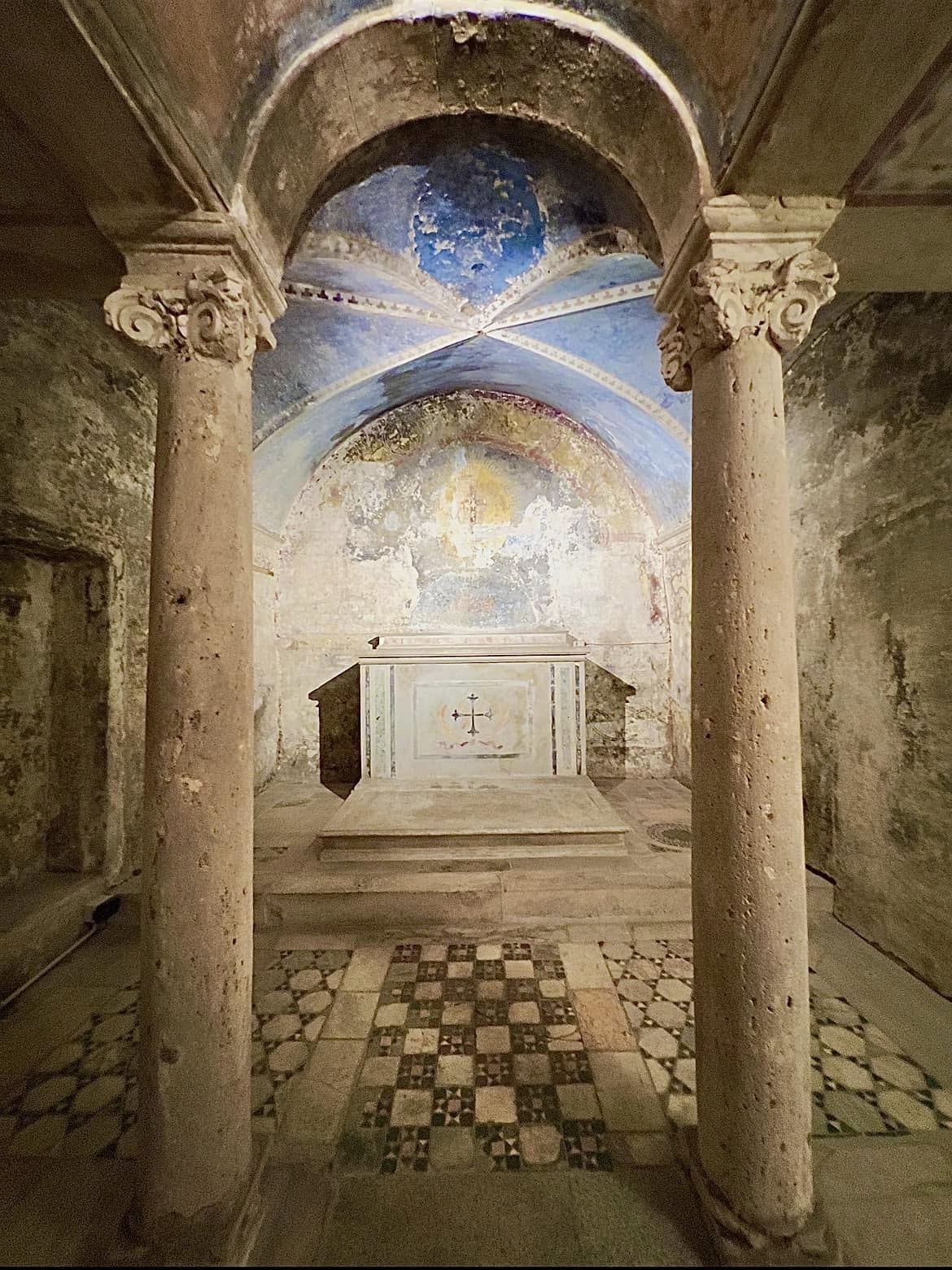
Crypt of
Sant'Agnese in Agone
Rione Parione
Rome
A Christian sanctuary formed inside a Roman stadium.
The lower spaces of Sant'Agnese in Agone preserve a physical connection between the architecture of Domitian's stadium and the later Christian history of Piazza Navona.
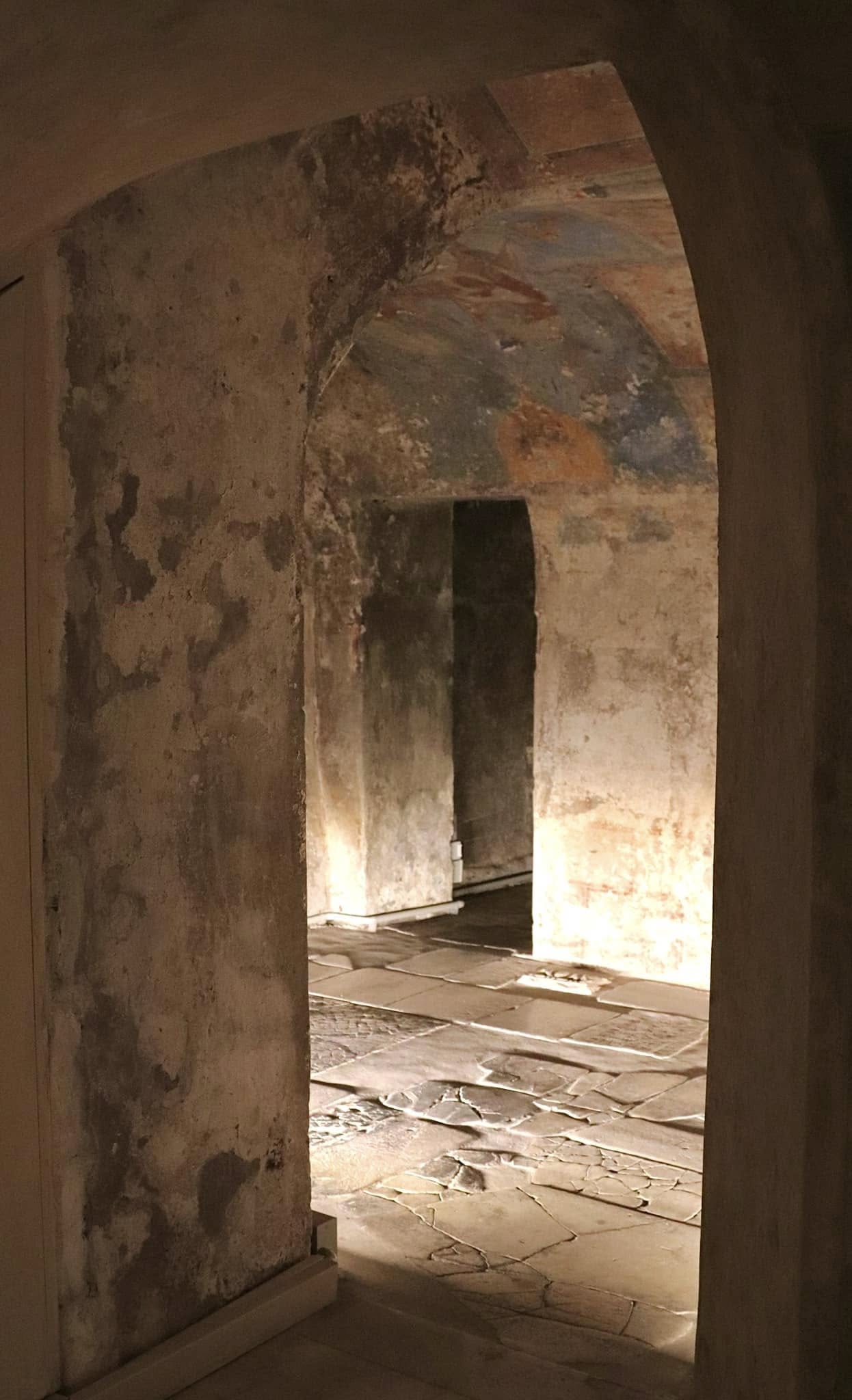
The crypt, traditionally known as the Sacellum Infimum, occupies three rooms created from structures belonging to the Stadium of Domitian.
These spaces later became part of the earlier church dedicated to Saint Agnes. They survived subsequent rebuilding and today form the principal material link between the present church and the Roman structure on which this side of Piazza Navona developed.
Three rooms from the Stadium of Domitian.
The archaeological importance of the crypt begins with its architecture rather than with the later church.
The lower sanctuary was formed within three spaces associated with the ancient stadium inaugurated under Domitian in the first century AD.
Piazza Navona still preserves the overall form of the stadium above ground. Here, however, the relationship becomes architectural: parts of the ancient building survive within the fabric of the later religious complex.
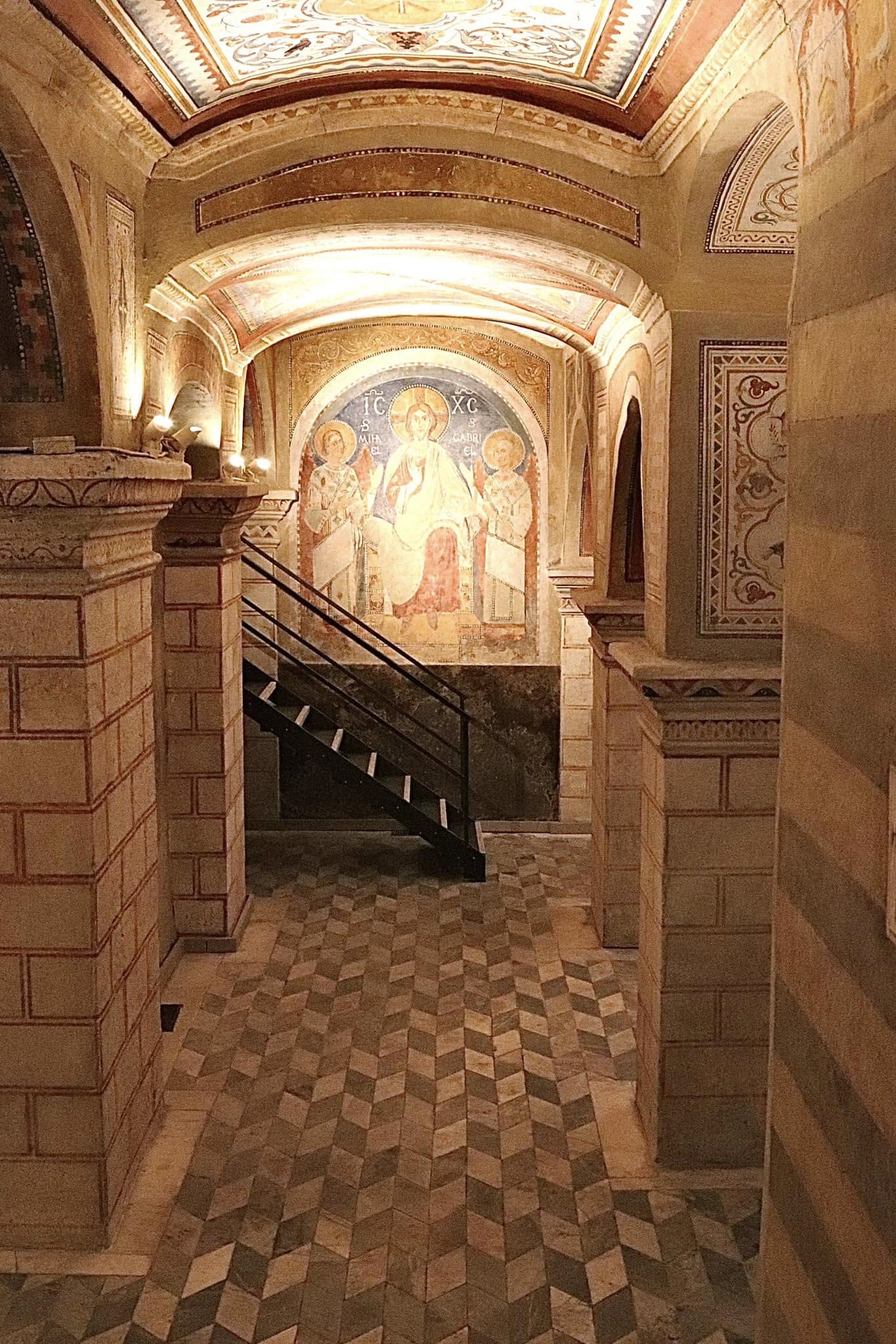
From stadium architecture to sacred space.
The Roman rooms were not preserved as an archaeological monument. They survived because later generations continued to use them.
As the Stadium of Domitian lost its original function, buildings and small places of worship developed among and above its surviving structures.
A sanctuary dedicated to Agnes became established here, and in 1123 Pope Callistus II enlarged the earlier oratory into a small basilica.
The orientation and architectural organisation changed again with the construction of the present Baroque church in the seventeenth century, while the lower rooms remained.
One structure. Several historical identities.
The lower level records a long process of reuse rather than a single moment in the history of the site.
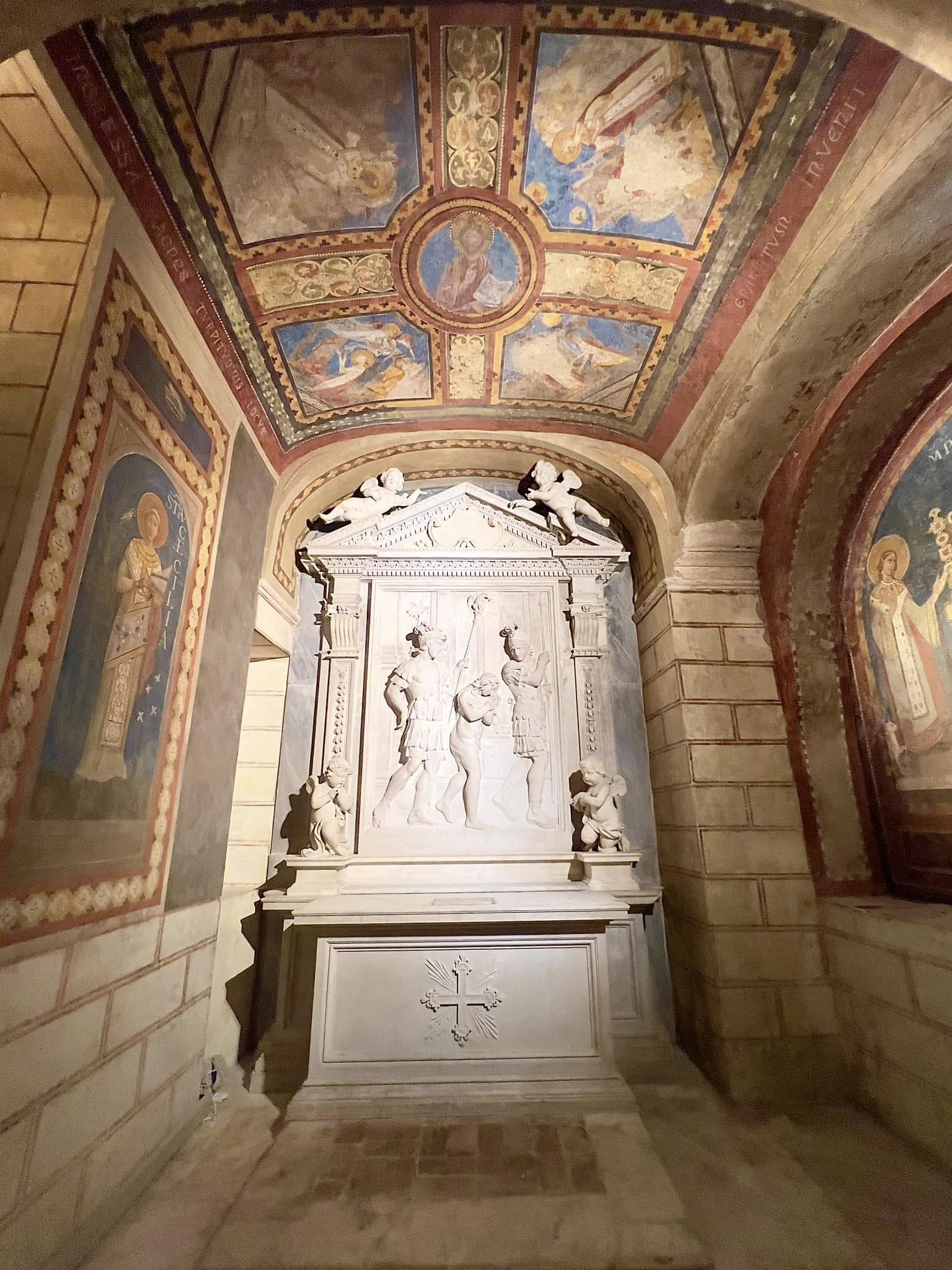
What the archaeology shows — and what tradition remembers.
The physical survival of rooms belonging to the Stadium of Domitian is archaeological evidence.
The identification of this precise location with episodes in the martyrdom of Saint Agnes belongs to a long religious tradition.
Christian tradition associates this part of the stadium with the persecution and martyrdom of Agnes in the early fourth century.
The sanctuary was venerated as the place connected with her martyrdom from the early medieval period, but the surviving Roman architecture by itself does not demonstrate the individual events described by the later hagiographic tradition.
The lower sanctuary survived when the church changed around it.
The crypt is the principal surviving component of the earlier church associated with this location.
The medieval building did not share the same architectural configuration as the church visible today. Its principal entrance was towards present-day Via dell'Anima, while its apse faced the former arena of the stadium.
The construction of the Baroque church beginning in the seventeenth century radically changed the architecture above. The lower sanctuary, however, was retained.
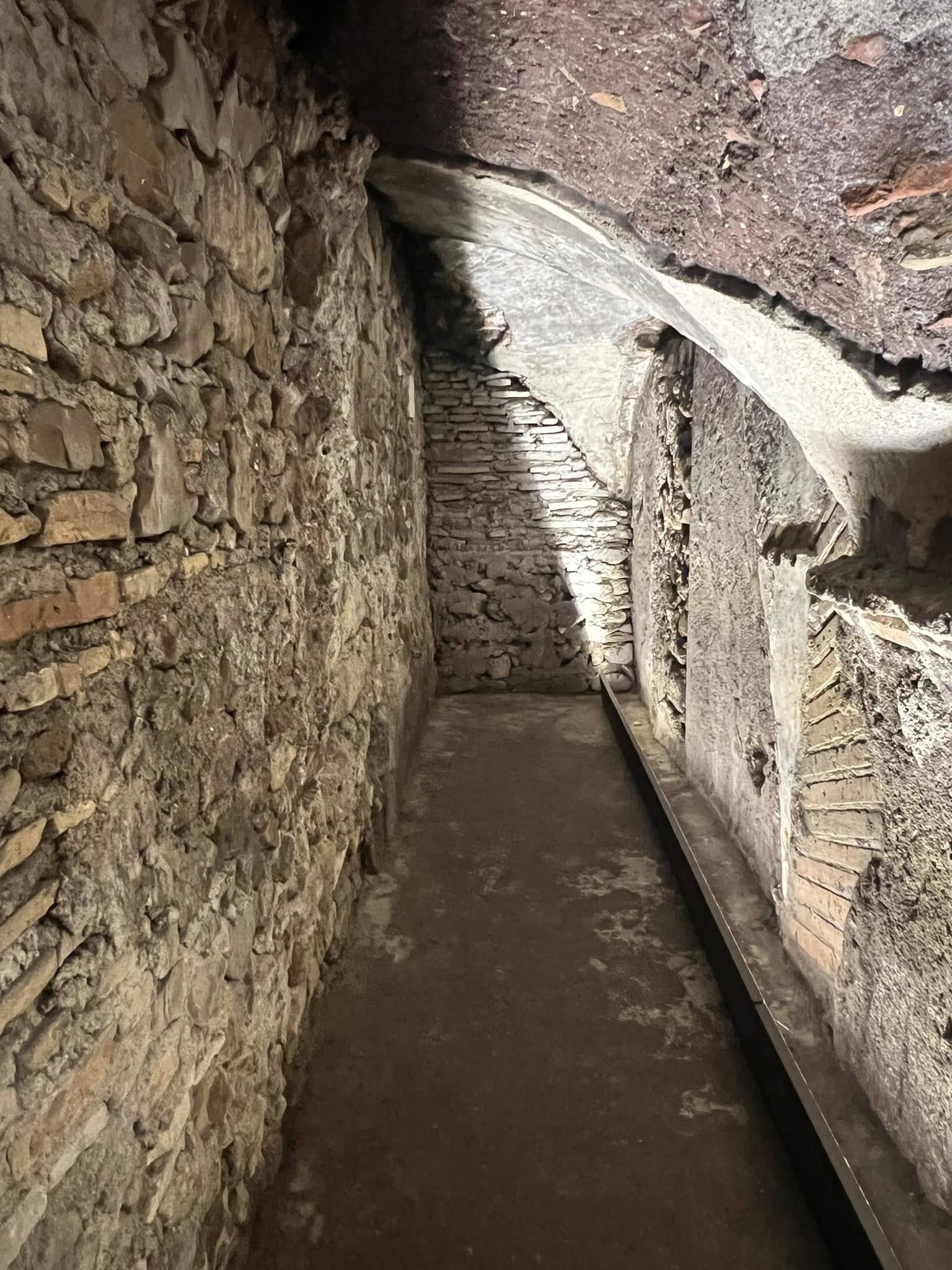
The survival of the crypt comes with a persistent problem.
Moisture has affected the lower spaces for centuries.
Historical records describe repeated problems with humidity and flooding. Borromini carried out work here in 1653, and further interventions followed in later periods.
Conservation studies have continued to investigate rising damp, groundwater and rainwater infiltration. The high humidity has severely damaged much of the painted decoration once visible on the walls and vaults.
In this case the environmental conditions of the subsurface are part of the continuing history of the monument.
A Roman building became part of the architecture of memory.
Sant'Agnese in Agone demonstrates a different form of archaeological survival from an excavated monument.
Conservation conditions determine access.
The crypt should not currently be treated as a standard visitor attraction with guaranteed public access.
Official material from Sant'Agnese in Agone describes the crypt as closed to tourists in connection with conservation work and persistent humidity problems.
Turismo Roma advises visitors to contact Sant'Agnese in Agone directly for current visiting arrangements. Access conditions should therefore be checked with the church before planning any visit.
Explore more archaeological places across Rome.
Build a journey around archaeology that can genuinely be accessed.
Underground Rome designs private archaeological journeys according to your interests, available time and the sites that can actually be visited during your stay.
Design Your Journeyby Rome Private Experience
Underground Rome is dedicated specifically to Rome's archaeological and historic subsurface.
For broader private programmes across Rome, corporate experiences and complex group arrangements, visit Rome Private Experience .