Archaeology beneath Palazzo della Cancelleria
Below a Renaissance palace, the ancient Campus Martius is still wet.
The archaeology beneath Palazzo della Cancelleria preserves an unusual meeting between funerary architecture and the hydraulic landscape of ancient Rome.
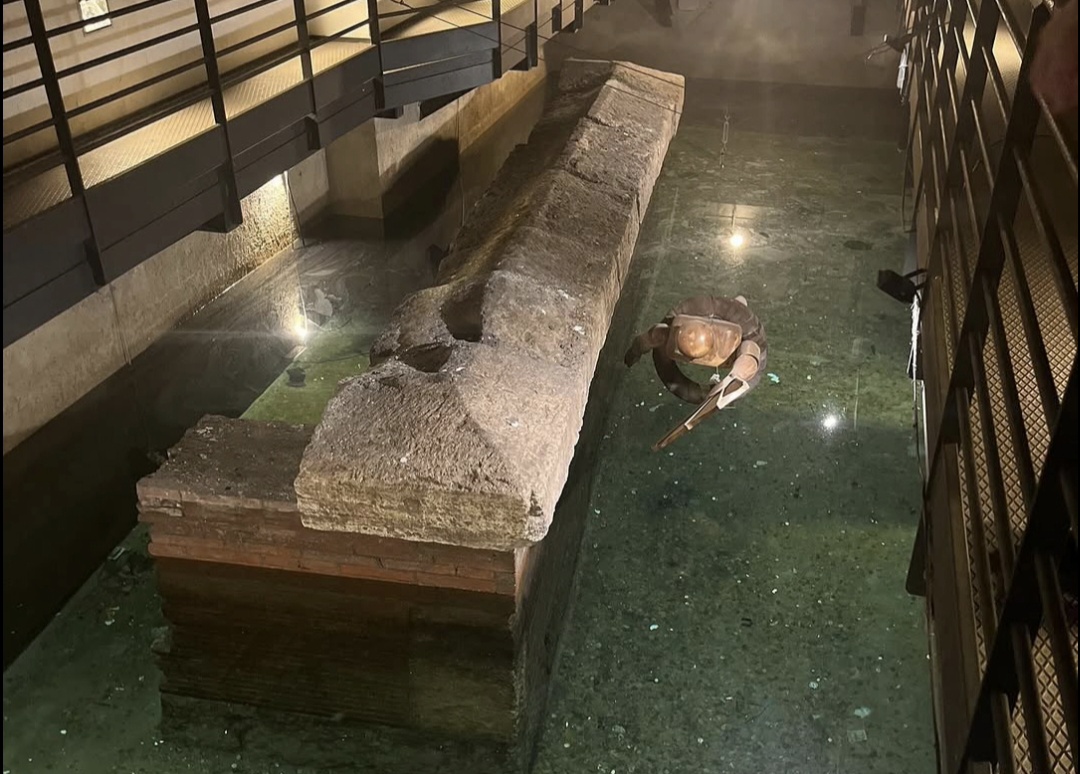
Below the Renaissance complex survives the funerary monument associated with Aulus Hirtius, consul of 43 BC and one of the commanders killed during the fighting at Mutina against the forces of Mark Antony.
Beside it runs the archaeological trace of the Euripus, the artificial water channel that crossed this sector of the Campus Martius and carried water toward the Tiber.
Today water occupies part of the archaeological space around the tomb, creating a direct physical reminder of a district whose ancient development was closely conditioned by water.
A public burial for a consul killed in civil war.
Aulus Hirtius and his fellow consul Gaius Vibius Pansa died in 43 BC during the conflict around Mutina, in the turbulent period following the assassination of Julius Caesar.
Ancient literary evidence records that the two consuls received the exceptional honour of public burial in the Campus Martius.
The structure discovered beneath Palazzo della Cancelleria has been identified with the monument of Hirtius through inscribed boundary markers bearing his name.
The surviving archaeological remains therefore connect a precise political event of the late Republic with a physical location in the western Campus Martius.
Water was part of the architecture of the Campus Martius.
Ancient topography in this part of Rome cannot be reconstructed from buildings alone. The western Campus Martius was low-lying, closely connected with the Tiber and repeatedly shaped by hydraulic infrastructure.
The Euripus formed part of that system. It carried water across the district toward the river and was connected with the landscape created around Agrippa's monumental projects.
Beneath the Cancelleria, the relationship between water and archaeology remains physically visible. Water infiltrates the archaeological level and occupies the area around the surviving structures.
The result is not merely atmospheric. It helps explain the environmental conditions within which this part of ancient Rome developed.
The ancient hydraulic landscape still leaves a physical trace.
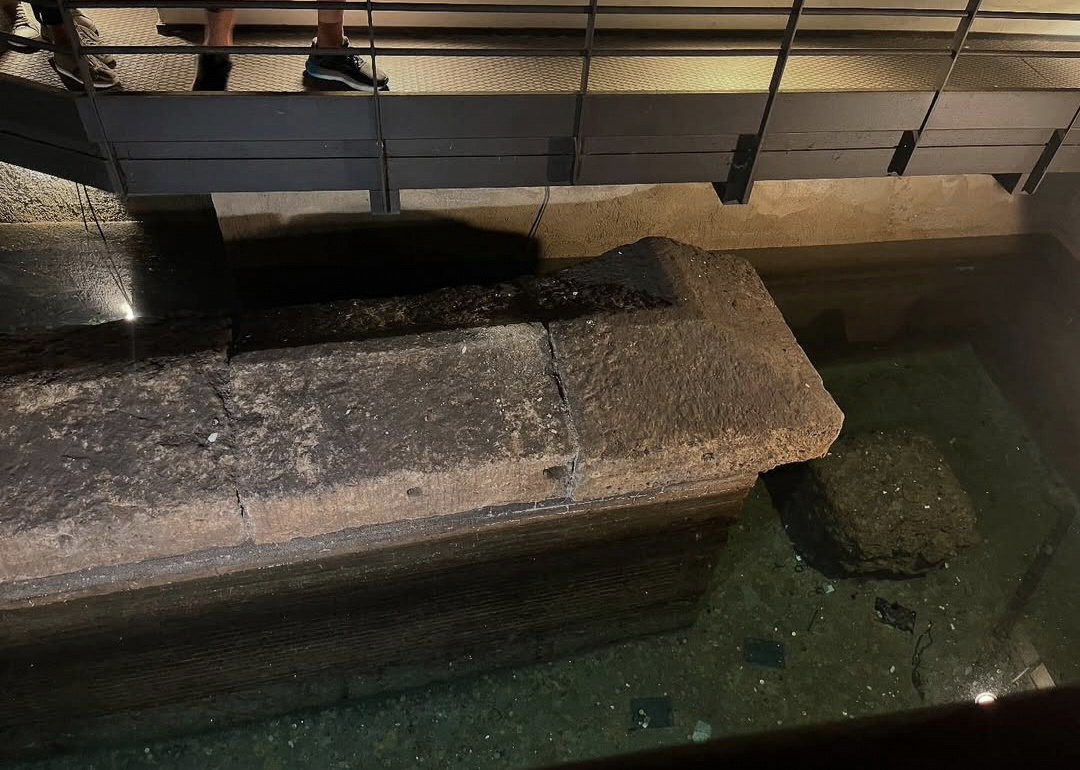
The archaeological remains are now encountered in conditions very different from those of the first century BC. Parts of the ancient structures stand in water within the foundations of the later palace.
This water should not be confused with an intact Roman ornamental pool. The present flooded condition is associated with the archaeological and hydraulic context of the Euripus and subsequent changes to the site.
What survives is therefore particularly valuable for reading the ancient topography: funerary architecture, hydraulic infrastructure and the modern building occupy the same vertical section of the city.
Three urban systems occupy the same coordinates.
Funerary landscape
The burial of Hirtius belongs to a period when exceptional funerary monuments could occupy this sector of the Campus Martius.
Hydraulic landscape
Water management and the monumental development associated with Agrippa reorganised the physical environment of the district.
Palazzo della Cancelleria
The Renaissance palace established a new architectural scale above the ancient remains while preserving them below its modern ground level.
A fragment of the Campus Martius survives inside a later building.
Palazzo della Cancelleria demonstrates why archaeology in Rome cannot always be separated into individual monuments with clear boundaries.
The Roman remains survive because later architecture incorporated the same ground rather than leaving it as an isolated archaeological zone.
Below the present palace, a Republican burial, an ancient water system, later foundations and modern interventions intersect.
Reading them together reconstructs something larger than a tomb: the physical development of one small part of the Campus Martius.
An archaeological area inside an active extraterritorial complex.
Palazzo della Cancelleria is a property of the Holy See with extraterritorial status. The archaeological complex beneath it falls within the archaeological responsibilities of the Vatican Museums.
Access to the archaeological area should not be treated as ordinary museum admission. Visiting arrangements depend on the current use of the palace and available access programmes and should be verified before planning a visit.
Institutional Sources
Alessandro Tanzilli
The photographs documenting the archaeological area beneath Palazzo della Cancelleria on this page are by Alessandro Tanzilli. @alessandrotanz_
Design Your Journey
Underground Rome creates private archaeological journeys selected around your interests, available access and time in the city.
Design Your Journey →Underground Rome is the specialist archaeological project of Rome Private Experience. Corporate programmes, incentive travel and complex private arrangements are managed through Rome Private Experience.
Rome Private Experience →